


Turbine: Settle large trades at zero spread

Middlemen eat your trading profits
On average, you pay 7–8 bps in spread to trade onchain. Together, we pay $9M per day and $3.2B per year. If you do 80M in weekly volume, on a 10M prop fund, you lose $2.8M (28%) to fees.
On large trades, the spread is even higher, not 8bps, but 50, 100, or 500 bps and more.
But swapping should be simple: You sell, I buy. Where does all this cost come from?
Long story short: Middlemen sold us the idea that fast trading is THE way to trade.
Ethereum is game-changing technology, literally, so can we change this game?
Can you buy $1M of ETH/AAVE/UNI without "price impact" (fees)?
You can.
Turbine: Trade Slow and Pay Less
Turbine is built to settle large trades at the lowest spread in finance. Lower than any exchange in DeFi, CeFi, and even TradFi.
Turbine has no continuous settlement, needs no market makers, no arbitrage, and has no hidden fees.
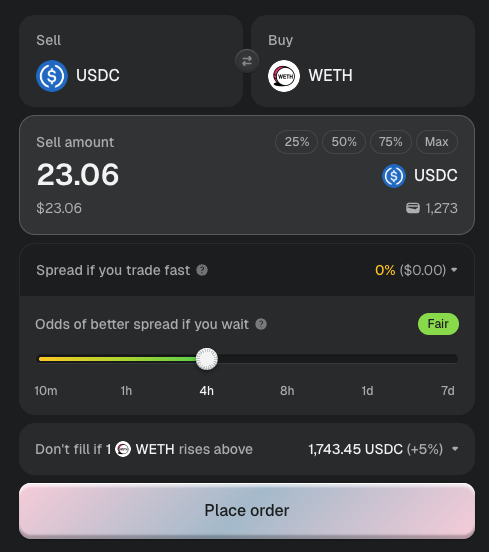
Instead, in Turbine, you settle with other traders and onchain liquidity. Slowly. The slower, the better your price gets.
Settle at zero spread
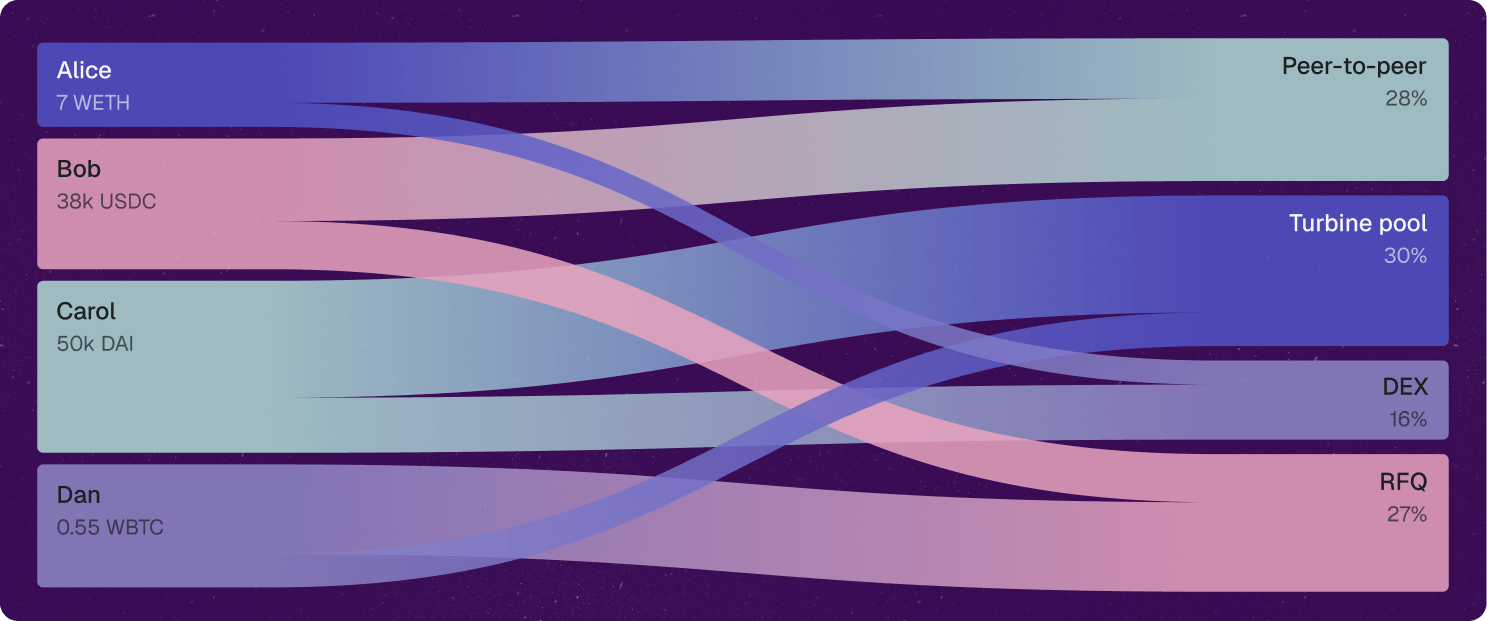
Turbine settles you with other traders and with all DeFi liquidity.
- The deepest liquidity in DeFi: Every block, Turbine settles you in a batch with other Turbine orders and LP and all liquidity in DeFi. → See how Turbine's batch solver (APEX) works.
- Get paid to wait: Wait for traders in a hurry (and willing to pay a spread) to settle for better than the market mid-price.
Worst case, you pay the spread you pay on other aggregators. Best case, you get paid by fast traders to settle.
Orders run for minutes or days and never get stuck

In Turbine, your order moves with the market, is invisible to frontrunners, and cannot be sniped by fast traders.
- Orders don’t get stuck: A limit order goes stale: You either overpay, or it doesn't settle. In Turbine, your order follows the market. It pays a low spread and settles by the deadline.
- Orders read price from fast exchanges: Fast exchanges (like Binance, Hyperliquid, Lighter) tell Turbine the current market price every 500ms (How the oracle works).
- Orders protect themselves from bots: Every order and cancellation waits 6 seconds before it enters Turbine’s book. By then, sitting orders are up to date with the latest CEX market price.
- Orders are invisible: Your order is stored in Turbine's TEE, only accessible to you and invisible until it settles.
Your order follows the market and settles when the spread is low. The more time you give your order, the more you save.
Long-running orders that don’t go stale make peer-to-peer trades possible.
Trade with Peers Today
Trade slow and pay less.
→ Make your first patient trade
Good prices come to those who wait.
About
Turbine is built by PropellerHeads, audited by Trail of Bits and backed by General Catalyst, Delphi, Faculty, Uniswap Labs, Circle, and 82 market makers, traders, and other strategic partners.
Built on
Turbine would not be possible without the work of the teams and researchers who built the tools and produced the research Turbine builds on:
- Phala: Phala hosts the TEEs that make Turbine both private and verifiable.
- Uniswap v4: Turbine pools are a custom Uniswap v4 hook. Turbine also flashloans the liquidity to efficiently settle batches from v4 vaults.
- Oracles: External markets (Binance, BingX, Bitget, Coinbase, Hyperliquid, Kraken, KuCoin, Lighter, and OKX) provide the prices that guide your orders and LP in Turbine.
- Eric Budish: Among the many researchers whose ideas contributed to Turbine, Eric Budish had the biggest influence. Thank you for your seminal papers.
- SPEEDEX: Geoffrey Ramseyer's SPEEDEX was an essential reference for Turbine’s batch settlement algorithm APEX.
- BuilderNet: Turbine batches settle through Flashbot’s trustless builder.
- Tycho: Tycho’s indexing and rust native simulation allow Turbine to include AMM liquidity in Turbine batches and simulate at the speed that APEX needs.
- Fynd: Fynd provides trustless DEX quotes that set your order’s spread and runs alongside APEX to settle your order at the best price.
- Ethereum: It's unlikely we would have ended up here without Ethereum. Ethereum is anti-middlemen tech, and its example inspired Turbine’s principles.


